How Cargoplot Differs from Traditional Freight Forwarders
Endless email chains, vague cost overviews, and slow quotes—as an importer, does this sound familiar? The feeling that you never truly have control over your shipments is a common frustration. The traditional method of working with freight forwarders is often outdated, inefficient, and more expensive than necessary. In this article, we dive into the specific differences between the old status quo and the modern digital approach. You will learn exactly how to overcome the pain points of manual logistics, from transparency to tracking, so you can stop wasting time and start optimizing your supply chain.
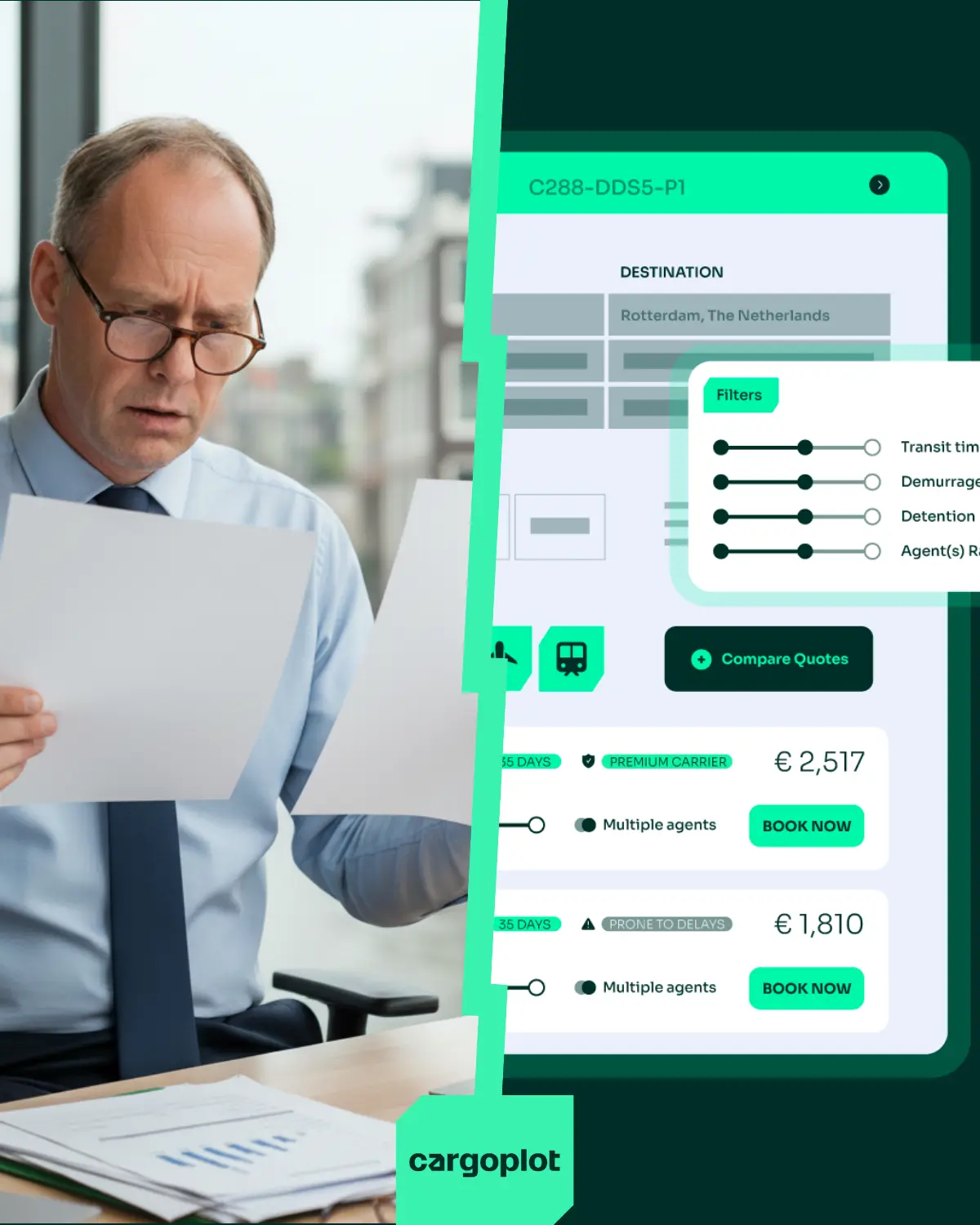


As an importer, you likely know the drill: infinite email threads with your forwarder, unclear cost breakdowns, slow quotations, and the nagging feeling that you are never really in control of your shipments. The traditional way of working with freight forwarders is outdated, inefficient, and often more expensive than necessary. Cargoplot does it differently, with a platform specialized in importing from Asia to the Benelux and NRW.
The Pain Points of Traditional Freight Forwarding
1. Lack of Cost Transparency
With traditional forwarders, you often receive a single lump sum without a clear specification. What exactly are you paying for sea freight? What are the local charges? And how much margin is the forwarder adding?
Even worse: many importers receive five or more invoices for a single shipment—from the supplier, the forwarder, customs, and various intermediaries. This makes cost management and accounting unnecessarily complex and time-consuming.
How Cargoplot Solves This: The Cargoplot platform displays a fully transparent cost breakdown for every option. You see exactly what you are paying for sea freight, local charges, and even the forwarder's margin. Furthermore, Cargoplot consolidates all transport-related costs (from pickup in China to delivery at your warehouse in the Netherlands, including customs) into a single, clear invoice. From five invoices down to one.
2. Slow Quotation Processes
The traditional process? Sending an email to your forwarder, waiting for a reply (one to two days is no exception), and in the meantime, rates keep changing and available capacity disappears.
How Cargoplot Solves This: For shipments from Asia, all quotes are automated: you see your options instantly. No more waiting. This speed translates directly into a competitive advantage: you can lock in favorable rates immediately, and your team can focus on strategic tasks instead of chasing information.
3. Manually Comparing Quotes in Excel
Many importers work with four or more different forwarders and have to manually compare quotes in Excel. This is time-consuming, prone to error, and almost impossible to keep up with during peak periods.
How Cargoplot Solves This: Cargoplot isn’t tied to one agent, contract, or carrier. The platform puts options from multiple agents and carriers in Asia side by side on one screen. That gives you more capacity and more choice for your shipment from Asia. You can instantly compare prices, transit times, and carrier reliability. No more back-and-forth emailing, no manual data entry in Excel.
4. No Control Over Carrier Selection
Traditional forwarders or suppliers often choose carriers based on their own profit margins, not your best interests. The result? Your container is placed with an unreliable carrier known for delays.
How Cargoplot Solves This: The platform shows options from multiple agents and carriers, allowing you to choose based on price, transit time, and reliability. Cargoplot uses data to label carriers as 'Premium' (consistently on time, few delays) or 'Prone to delays'. For urgent shipments, you can consciously choose a reliable carrier like Maersk instead of a less reliable option. You are in control.
5. Outdated Tracking and Updates
Weekly email updates are obsolete the moment you receive them. Shipments are frequently delayed by 5-10 days. Inaccurate ETAs make it impossible to plan for arrival and onward delivery.
How Cargoplot Solves This: The platform offers live, real-time tracking for every shipment. You can see your container on a map at any moment. The estimated time of arrival (ETA) and departure (ETD) are automatically updated as circumstances change, and you receive an instant notification. This is far more accurate and current than a static weekly email.
6. Manual Document Management
The current process is fragmented and manual. You constantly have to chase information and documents, which are often incorrect or difficult to manage. The end result: endless email chains and scattered files.
How Cargoplot Solves This: A centralized platform where all shipment information, including live tracking, automatically updated ETAs, and all relevant documents (packing lists, invoices, bills of lading) are stored in one place. Communication takes place via a shipment-specific chat. Proactive notifications are sent when changes occur. You no longer need to constantly ask for updates. One dashboard, one source of truth, accessible 24/7.
7. Uncertainty Regarding Demurrage and Detention
Unclear information about 'free days' for demurrage and detention leads to uncertainty and potential hidden costs that can amount to thousands of euros.
How Cargoplot Solves This: The platform offers full transparency regarding free days upfront. When you view a quote, you clearly see how many demurrage and detention-free days are offered by that carrier and agent. Additionally, you can use a filter to specifically search for shipping options that meet your minimum requirement for free days.
8. Last-Mile Complications
Managing the final leg of the shipment (last-mile) is an extra, time-consuming step that many importers would rather avoid. Many think that FOB (Free On Board) means you have to figure everything out yourself after the goods leave the port.
How Cargoplot Solves This: Although Cargoplot specializes in FOB, the platform feels like a door-to-door service. When you request a quote, you can enter your final warehouse address as the destination. The system then delivers an all-in price including sea freight, customs clearance, and the final road transport to your door. All components are transparently specified in the quote. Cargoplot handles the coordination, so you don't have to arrange a separate truck yourself.
9. Unresponsive Forwarders
Traditional freight forwarders often 'disappear' when you ask for detailed cost breakdowns. No direct contact person, slow reactions, vague quotes.
How Cargoplot Solves This: First, the platform offers a fully transparent quote specification for every option, so you see exactly what you are paying for, including the Cargoplot fee. Second, you get a dedicated account manager with a direct mobile number, plus contact details for the operational team. All communication is also centralized in a chat log per shipment within the platform, so nothing gets lost and you always get a fast answer.
Back to the Core: Control Over Your Shipments
Many importers currently lack control over their shipments because their Chinese supplier insists on arranging the transport. This leads to a lack of transparency and inflated costs. Suppliers often treat freight as an extra revenue center and add significant margins.
In a recent example at Cargoplot, it was shown that a supplier charged nearly €6,000 for two containers, while the same shipment could be arranged for under €5,000 during the same period. A saving of more than €1,000 on a single shipment.
The Key: Switching from supplier-arranged shipping (CIF/CFR) to arranging it yourself (FOB). A platform like Cargoplot makes this possible and gives you full control and cost transparency back.
Conclusion: Cargoplot vs. Traditional Freight Forwarders
Cargoplot is not just a digital layer over the old system. It is a fundamentally different way of working:
- More Capacity and Choice from Asia: You see options from multiple agents and carriers simultaneously, not just one forwarder with their own interests.
- Real-time Data: Live tracking, automatic updates, direct notifications.
- Complete Transparency: Detailed cost specifications, visible margins, one consolidated invoice.
- You Decide: Choose your carrier yourself based on price, speed, and reliability.
- Centralized Communication: All documents, tracking, and messages in one place.
- Door-to-door on FOB terms: All logistics arranged, from factory to warehouse.
The question is not whether you should switch to a modern approach like Cargoplot. The question is how much money, time, and frustration you still want to waste on the old system.
With Cargoplot, you get not only better prices and more choice but, most importantly, control back over your supply chain. You know what you are paying, where your shipment is, and when it arrives. Without outdated updates, without hidden costs, without having to beg for information.
Stop wasting time on Excel sheets and unclear invoices. Experience how Cargoplot’s digital platform makes your logistics more efficient, transparent, and cheaper.
Frequently asked questions on Cargoplot vs. traditional forwarders
Why is Cargoplot more transparent than a regular forwarder?
Cargoplot displays a full specification of all costs (such as sea freight, local charges, and margins) and consolidates all transport costs onto a single, clear invoice. With traditional forwarders, you often receive unclear collective invoices or even have to handle multiple separate invoices from different parties.
How fast will I receive a quote from Cargoplot?
In contrast to the traditional process, where you often have to wait one to two days for an email, all quotes for shipments from Asia are automated on the Cargoplot platform. This allows you to lock in favorable rates immediately and move faster.
Can I choose the carrier myself at Cargoplot?
Yes. Where traditional forwarders often choose carriers based on their own margins, Cargoplot gives you the control. You can choose based on price, transit time, and reliability scores, with carriers clearly labeled as 'Premium' or 'Prone to delays'.
How does tracking work at Cargoplot?
Cargoplot offers live, real-time tracking where you can follow the container on a map. Estimated arrival and departure times (ETA/ETD) are automatically updated. This is a major difference compared to the manual, often outdated weekly email updates from traditional parties.
Does Cargoplot also handle transport from the port to my warehouse?
Yes. Although Cargoplot specializes in FOB terms, the service feels like door-to-door. By entering your warehouse address, you get an all-in price including sea freight, customs clearance, and final road transport. You do not need to arrange a separate transporter yourself.
Related content
.webp)



Sign up for more supply chain insights:
No spam, just knowledge.