Importing goods without the hassle: from hidden costs to full control
In this article, we dig deep into the three pillars of successful importing: price transparency, planning reliability, and the importance of availability. We explain why cheap transport is often expensive in the end, and how the right strategy (and technology) puts you back in control.


.webp)
You spent months searching for the perfect product, tested samples, and finally closed a deal with a manufacturer in China. The margin looks fantastic on paper. The supplier even offers to arrange transport at a bargain price. "Don't worry," they say, "we'll handle everything all the way to the port of Rotterdam."
Weeks later, the shipment arrives. But instead of your goods, you first receive an invoice from an agent you've never heard of. The cost? Hundreds of euros in "handling fees," "terminal fees," and "CISF surcharges." Meanwhile, your cargo is stuck in customs and nobody knows exactly when it will be delivered. Your carefully calculated profit margin evaporates before your eyes.
Unfortunately, this scenario is the reality for many e-commerce entrepreneurs importing goods for the first time. Logistics is often treated as an afterthought, when in reality it's one of the biggest risk factors for your profitability.
Successful importing is about more than low rates. In this article, we show how insight into costs, predictable planning, and direct availability make the difference — and how smart choices and technology put you back in control of your import process.
1. The price transparency paradox: why CIF is rarely the better deal
When importing goods, everything comes down to the Incoterms. Many suppliers default to offering CIF (Cost, Insurance, and Freight). Under this term, the supplier pays for transport all the way to the port of arrival.
That sounds appealing: it's cheap and easy. But in logistics, "free" doesn't exist.
The pitfall of LCL shipments when importing goods
The risk lies mainly in LCL shipments (Less than Container Load). The forwarding agent in China offers your supplier an absurdly low rate to secure the cargo. That loss gets recouped on arrival in the Netherlands: the local agent inflates the invoice with charges you never approved, such as the notorious China Import Service Fee (CISF).
Because you didn't hire that forwarding agent, you have no negotiating position. You have to pay, or you don't get your goods. That's how a "cheap" €200 shipment can suddenly cost €800 on arrival.
2. The customs maze and paperwork chaos
Besides cost, compliance is a major pitfall. Logistics is really about moving data and documents. When that goes wrong — the wrong HS codes, missing CE certificates — your shipment grinds to a halt.
The problem with traditional forwarders is fragmentation. You often work with one party for sea freight, another for customs, and a third for road transport. That means three document flows, three points of contact, and three times the chance of errors.
3. Operational chaos: when does it actually arrive?
In e-commerce, timing is critical for your inventory planning. But how reliable is a date, really?
With traditional forwarders, an ETA (Estimated Time of Arrival) is often little more than a guess. You don't know which carrier is sailing, or whether that route is known for delays.
Insight through data: Premium vs. Prone to delays
Modern importing calls for honesty about transit times. There's no point promising a date that won't be met. That's why, in the Cargoplot platform, we work with transparent labels.
When booking, you see immediately whether a route and carrier are labelled "Premium" (high reliability) or "Prone to delays." These labels are based on real, current data. That lets you make the trade-off yourself: go for the lowest price with a risk of delay, or pay a bit more for certainty because your stock is running low?
The solution: Cargoplot's "multi-agent" advantage
To eliminate these risks, you can switch to FOB (Free On Board) or EXW (Ex Works). But then you face a new choice: which forwarder do you pick?
Traditional forwarders often work with just one partner in China. That's risky. If that partner has no space on the vessel — which happens often during peak season — you'll hear: "Sorry, we're full." Or you pay top dollar on the spot market.
How Cargoplot does it differently
Cargoplot works fundamentally differently. We connect the capacity of multiple specialised agents in a single platform.
Why does this matter to you?
- The widest availability: our agents buy space ("allocations") with carriers well in advance. If one agent is full, another often still has room. That means we offer the broadest capacity, even when the market seems "locked."
- Sharper pricing: because we show prices from different partners in a single overview, you always see the best option for your specific route.
- One platform, no chaos: normally, working with five different agents is an administrative nightmare. At Cargoplot, all these parties operate inside our software. You get one dashboard, one invoice, one point of contact.
From any port to your front door
Many digital forwarders are limited to specific routes. Cargoplot is unique because you can book a shipment straight from any port in the world to your own front door.
In your dashboard, you see exactly which local forwarder and carrier your goods are travelling with. No black box — full transparency about who's moving your freight.
The difference in numbers
Let's tally it up. What does that control actually deliver financially? The table below sketches a realistic scenario for an LCL shipment (1-2 CBM) to illustrate the difference.
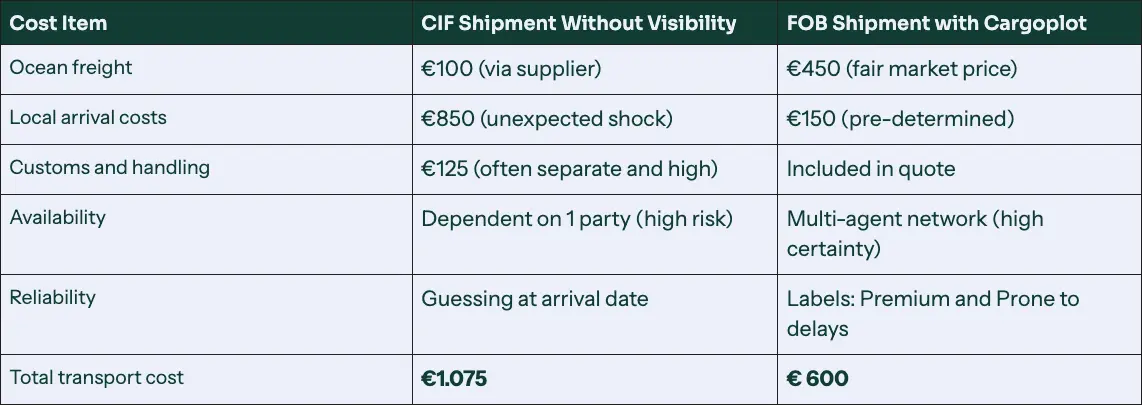
Disclaimer: the figures above are a rough calculation example purely to illustrate the cost structure between CIF and FOB. Sea freight rates are volatile and fluctuate daily based on market conditions, fuel prices, specific routes, and volumes. No rights can be derived from this example. For an exact price for your shipment, we recommend running an up-to-date calculation on our platform.
Conclusion: choose certainty
In the volatile world of e-commerce, you can't afford to gamble with your inventory. By choosing a partner that bundles multiple networks into a single platform, you eliminate hidden costs — and secure your space on board.
Stop hoping for the best. Start building a predictable, profitable supply chain.
Done with vague invoices and uncertain lead times? Get a guaranteed all-in price for your shipment within 1 minute through our platform. See availability instantly, compare routes, and book with no surprises afterwards.
Frequently asked questions about importing goods
Why is an LCL shipment (CIF) through my supplier often more expensive than other incoterms?
With CIF deliveries, and specifically LCL shipments, Chinese forwarding agents often offer the supplier extremely low rates. They recoup that loss on arrival in the Netherlands by passing high, hidden costs (such as CISF surcharges) on to you as the importer. As a result, you often end up paying much more than you would with a transparent FOB booking.
What's the advantage of Cargoplot's multi-agent model?
Traditional forwarders often work with a single partner, so during busy periods you get told the ship is full. Cargoplot connects multiple specialised agents in one platform. Because these agents buy space in advance (allocations), there's almost always availability, even when the market is "locked."
What's the difference between FOB and EXW?
Under FOB (Free On Board), the supplier arranges transport up to the vessel; from there, you take over. That's a good balance between control and convenience. Under EXW (Ex Works), you're responsible from the factory in China onward. That gives maximum control and transparency, since the supplier can't hide margins in the pre-carriage.
Related content




Sign up for more supply chain insights:
No spam, just knowledge.