Sea freight without surprises: the guide to smart importing
The deal with your supplier is done. The excitement is real. And then comes the big question: how do you get those goods from Shanghai to your warehouse in Breda without your margin evaporating along the way? Welcome to the world of sea freight, traditionally as unfathomable as the deepest ocean. This guide is your compass. We'll skip the jargon and show you exactly where the hidden costs are lurking, so you can take the reins.


FCL or LCL: your first crucial choice
Your first question: your own container or a shared one?
- FCL (Full Container Load): You rent an entire container. It's sealed at your supplier's site and only opened again once it reaches you.
- When? From around 18-20 CBM (cubic meters), this is often the best deal. It's also worth the extra security for smaller volumes with fragile goods.
- Advantage: Fewer handling moments, so less risk. Often a week faster than LCL.
- LCL (Less than Container Load): You share a container with goods from other importers.
- When? Ideal for volumes between 2 and 20 CBM.
- Disadvantage: More handling, a slightly higher risk of damage, and a longer transit time due to the consolidation process.
Pro tip: The tipping point where FCL becomes cheaper than LCL differs per route and largely depends on the container price. Enter your volume on the Cargoplot platform and you'll immediately see the all-in prices for both options. No guesswork, just concrete data.
Choosing the right container: 20ft vs. 40ft
If you go with FCL, you'll need one of these three workhorses in 95% of cases.
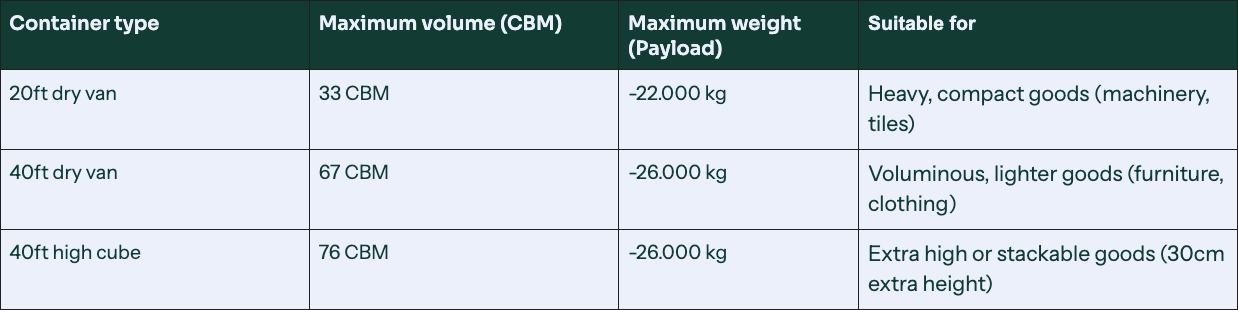
The most important pitfall: A 40ft container has double the space of a 20ft, but not double the load capacity. For heavy products, a 20ft container is often the only efficient option.
The anatomy of a shipment: where you can lose margin
A sea freight quote consists of several stages. Unexpected costs lurk at every stage.
- Pre-carriage: Transport from the factory to the port of departure.
- Pitfall: Waiting costs because your shipment wasn't ready on time or the export documents were incomplete.
- Origin & destination charges: Handling at the ports of departure and arrival. And this is where you really need to pay attention.
- Pitfall: The notorious THC (Terminal Handling Charges). These are the costs for loading and unloading the container at the terminal. Importers regularly come across quotes where the THC is conveniently 'forgotten'. That can mean an extra bill of hundreds of euros that you only find out about once the container is already sitting in port.
- Ocean freight: The actual sea voyage. This is often the headline rate used for advertising, but it's rarely the full cost picture.
- On-carriage: The final stage: transport from the port to your warehouse.
With traditional forwarders, you often only get the final bill afterwards. At Cargoplot, we believe in radical transparency. On our platform, you immediately see one all-in price with every cost item broken down individually. We even show you our margin. So you know 100% for certain where you stand, before you even book.
Get more grip on your sea freight
Importing is a powerful engine for your business, provided you keep costs tightly under control. The key is knowledge and the right partner. By seeing through the pitfalls and choosing a platform that guarantees full transparency, you turn a source of stress into a strategic advantage.
Instantly compare all-in rates from dozens of forwarders on our platform, or schedule a no-obligation call with one of our experts.
Frequently asked questions about importing by sea freight
What is the difference between FCL and LCL?
FCL (Full Container Load) means you rent an entire container, which is sealed at the supplier's site and only opened once it reaches you. It's ideal from around 20 CBM or with fragile goods. Advantages include fewer handling moments, so less risk, and often a faster transit time.
LCL (Less than Container Load) means you share the container with other importers. It's suitable for volumes between 2 and 20 CBM, but comes with more handling, a slightly higher risk of damage, and a longer transit time due to the consolidation process.
When does FCL become cheaper than LCL?
The tipping point differs per route and mainly depends on the container price. Generally, FCL is often cheaper from around 20 CBM. On the Cargoplot platform, you can enter your volume to compare the current all-in prices of FCL and LCL.
Why does container size matter?
The right size is crucial for efficiency and cost control. A 40ft container offers more volume but not double the load capacity of a 20ft. For heavy goods such as machinery or tiles, a 20ft container can be cheaper and more practical.
What container types are there, and when do you choose which one?
There are three commonly used container types for sea freight: the 20ft dry van, with a maximum volume of 33 CBM and a payload of around 22,000 kg, is suitable for heavy, compact goods such as machinery and tiles. The 40ft dry van offers 67 CBM and around 26,000 kg, ideal for bulky, lighter products such as furniture or clothing. The 40ft high cube has 76 CBM and also around 26,000 kg, making it suitable for extra tall or stackable goods, with about 30 cm of extra height. Note that a 40ft container does not have double the load capacity of a 20ft, which is why a 20ft container is often the most efficient choice for heavy goods.
Related content



Sign up for more supply chain insights:
No spam, just knowledge.